Heywood
Modernizing a defined benefit plan requires more than just new software; it requires a shift in mindset. SJCERA's CEO Renee Ostrander, discusses the strategic reasons behind SJCERA's recent PAS selection and how digital transformation is enabling their team to provide personalized support to 17,000 members.
When Renee Ostrander joined SJCERA two years ago, she found a team committed to its mission but ready for a digital evolution. The goal was simple yet ambitious: create efficiencies, increase data integrity and improve customer engagement. By moving away from the custom-built systems of the past, SJCERA is proving that administrative transformation can be achieved quickly and with clarity through the right partnerships.Tell us a little about SJCERA
 SJCERA stands for San Joaquin County Employees’ Retirement Association, and we’re a county system in California.
We were established by our county board of supervisors in 1946, so this year marks our 80th birthday. We’re very excited about that, and we’re looking forward to celebrating this summer.
We just crossed the $5 billion threshold for assets under management, so it’s a pretty exciting time for us.
We have 17,000 members, including our active, deferred and retired members. They are from over 10 employers; our county employer is the largest, and the other nine are made up of fire districts, city and even a public cemetery district and historical society.
SJCERA is run by a very small, lean team of 21 people. We talk about efficiency often and are always trying to be cost-conscious, so we all wear a lot of different hats and pitch in to ensure our members and employers are served.
What changes have you seen since joining SJCERA?
I joined SJCERA about two years ago, and I was really energised by our team's commitment to the mission. They had worked really hard prior to my arrival to lay a great foundation and were very open to the improvements that I had talked about when I showed up.
Over the last two years, we've had a pretty significant focus on technology, and we've been trying to do three key things and have touched on them in different projects:
-
Create efficiencies
We've added new technology to automate our monthly board agenda materials, which has really helped us make changes when we're preparing to post agenda items. -
Increase data integrity
We wanted a financial system to reconcile our investments. You can imagine that with $5bn, there's a lot of investment transactions, and that financial information is moving back and forth; we put in a system to help with data integrity, ensuring we're correctly tracking and recording all those transactions. -
Improve our customer engagement
At the end of 2025, we opened a temporary portal for retirees to retrieve their tax documents, marking the start of our digital engagement with our member population, allowing them to access their own data.
Our partnership now with Heywood is going to touch on all three of those areas with just the one project, so we're really looking forward to the efficiency, the increased data integrity from the information that we'll be getting from our employers and the opportunity to engage more with our members once we have the implementation go live next year.
Tell us about the process of selecting a new PAS supplier and what your aims were
When I first arrived at SJCERA, I began looking at the landscape of just administrative systems in general, and I saw several issues. What I was seeing were plans that really sought to build unique systems, but that comes with increased long-term maintenance costs, and each time you want to change something, there could be additional costs, with obsolescence already on the horizon.
When I looked at all that, I didn’t believe that fundamentally, we were all that unique as plans. Defined benefit systems are, at their core, the same across our state or even across the country. Yes, there are different laws to acknowledge, but essentially, defined benefits are the same.
When I released the RFP, I was really looking for someone who understood that we wanted a basic, already built system that could be put in place without a long runway. These projects can often take three, five or even ten years, and I didn’t want that. I was looking for something that was already built, more out-of-the-box, with minimal configuration from our side, that would be maintained and continually upgraded by the vendor.
The obvious benefit of a quicker implementation process is achieving efficiencies sooner, but a second, strategic reason was that I really wanted to look at our organization differently. There was a solid foundation of good employees, training, and people who handled the business well, and I wanted to build on that and use technology to open the doors to what else is possible.
Understanding our needs and what we wanted to ask for, I structured the RFP to get to know our vendors. It was important to me that whoever we selected would be a long-term partner – we were absolutely committed to getting to know the vendor and their proposed solution beyond just on paper.
We released the RFP in June, went through four rounds, including security assessments, before signing the contract in December. I really wanted to flip the script on procurement and not subscribe to the same way of doing things. I hope it leaves other plans with an inquisitive mind about how things can be changed.
We are super happy with the outcome; we saw exactly the benefits we wanted as we moved through the process, and now that we have the contract with Heywood in place, we’re really excited to see it come to fruition.
 What, if any parallels have you drawn between SJCERA and Heywood?
The biggest similarity I’ve seen across our organizations is the commitment to our members. It was clear to us from the very first meeting that Heywood is committed to the members that plans such as ours service.
They had an understanding of our needs because of their long tenure in the defined benefit world, but the number of questions, the pure curiosity, and the inquisitive nature to get to know US customers were really big for us.
We feel that it’s really critical to our success, knowing that we have a partner as committed to our members as we are. We’re very excited about the relationship blooming.
Have there been any pleasant surprises along the way?
From the first meeting, we were really warmed by the openness of the engagement; the real positivity and willingness to partner has been so encouraging.
When you get into projects with implementations, there are always issues you come up against or things to work through – having a partner who is willing and collaborative is a strong foundation for working through any difficulties together.
Looking to the future, what’s next on the horizon, and what are you most looking forward to?
This is probably what gets me most excited – I’m really looking forward to the future. We’ve already made technology improvements in the last two years, and now this big transformation we’re making with our administrative system is giving me so many visions of the future.
We’re already beginning to talk about what our resource allocation will look like and how we’ll be staffed in the future. The leadership team and I are very clear that we have no intention of reducing staff, but we are discussing redeploying resources to deliver value to our members.
The future looks to take those resources and capacity and deploy them to members, spending time educating them and engaging them early on in their careers, so they understand the benefit that’s provided. We want our team to spend time with our retirees, so they are aware of the benefits and understand them as their lives change.
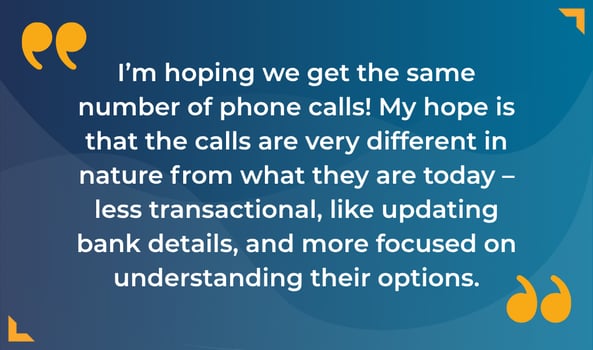
One of the most interesting questions I get asked is, “Are you excited to have your phone calls reduced, because people will have all these tools at their disposal?” My reaction seems to shock people when I say no. I’m hoping we get the same number of phone calls!
My hope is that the calls are very different in nature from what they are today – less transactional, like updating bank details, and more focused on understanding their options and what they mean.
We want our members to take their information and truly relate it to their personal scenarios, because we all face different circumstances in life, so the choices need to be unique to each person.
We want to make sure we’ve provided enough education and have the engagement to allow members to ask those questions. That’s what will help ensure they make good decisions for themselves and their future.
By choosing a solution that is maintained and continually upgraded, pension plans can focus on their core mission of delivering long-term value to their members.
Learn more about our pension administration software and why leading retirement systems partner with Heywood, here:
%20solutions/Small%20scheme%20streamlined%20solutions%20webinar.png?width=352&name=Small%20scheme%20streamlined%20solutions%20webinar.png)